Translate

Tuesday, July 16, 2013

Warning: Lots of EducBabble in this Post :-)... The Galaxy Education System

We have begun working at our host school in Rajkot. We are at the Wadi campus, which is part of The Galaxy Education System of schools (TGES). TGES is a private school, in the top ten private schools in all of India. This school is expensive compared to the other private schools we have seen. The school has standards (grades) 2-9 and the classrooms are located in what the staff and students call "huts." They literally have straw roofs and look like little resort cottages.

The huts that are classrooms. 

The Wadi campus in the rain...
I am still trying to figure out the schedule, but this school, and the TGES, are committed to a curriculum that encourages thinking and analyzing over the traditional Indian teaching that is very "talk and chalk" and teacher centered. The TGES promotes Teaching for Understanding (TFU), which was developed by Harvard professor of Education, David Perkins. At the school today, I observed a lot of the same strategies and activities that teachers in my school utilize. I saw Think-Pair-Share, graphic organizers, a lesson on how to summarize a non-fiction article, the Habits of Mind curriculum, vocabulary word walls and Point-Evidence-Explain writing structure.

Music teachers playing the harmonium and tabla drum during the morning meeting Sanskrit prayer. 

Students in "Wellness" class (P.E.) practicing field hockey skills. I even picked up a stick and juggled the ball for awhile. 

I got to co-teach with Pritha, a 7th grade literature teacher. 
The teachers work incredibly hard and even tailor the kind of learning (based on Multiple Intelligences) to each specific "batch" of students. Students are grouped by their preferences on the Multiple Intelligences inventory, so teachers make sure to include kinesthetic activities for one class, while doing more linguistic/verbal activities for another. A teacher told me that she never uses the same plans over again because the students and their preferences are always changing. Teachers on a learning team collaborate constantly, making sure to make interdisciplinary connections as much as possible.
Since we are looking at global education, I would like to see how other cultures, beliefs and ideas are imparted into the curriculum.

Some observations from today:

  • there are no bells and if a teacher decides she/he needs more time on a topic, they can talk to the other team members to extend the lesson. 
  • Students all have laptops and some of them are touch screen. They didn't have any problems logging on or issues with the network. 
  • Students begin learning English at the age of two, so they have been learning academic English for their whole school careers.
  • a consequence for not listening, arguing with the teacher or not paying attention in the class is a week out of class, doing assignments independently in another part of the building.
  • Technology is a centerpiece of these students' learning, not a supplement.
  • Teachers are called by their first name, followed by m'am or sir. 
  • Teachers spend a whole class period (50 minutes) on something that we would spend maybe 10 minutes on in American classrooms (i.e. copying notes from the board, unpacking one stanza of a poem)
Inside the hut. 


Morning prayer

A 5th grade teacher, introduces the different genres of literature. 


Sunday, July 14, 2013

Educating India

The purpose of this fellowship is to discover how globalization can impact the lives of students, teachers and their communities.  While in Bangalore, we had the chance to visit several primary and secondary schools in preparation for our work in Rajkot, Gujarat. The Teacher Foundation, which is an organization dedicated to enhancing the professional growth and competency of Indian teachers, informed us about and helped us process the complex education system.

There are two kinds of schools in India: government funded public schools and private schools. The public schools are required to follow a packaged, sequenced curriculum chosen by the Ministry of Education. Students are often given uniforms, shoes and books at no cost. Alternately, there is a popular private school sector that is in direct competition with the government schools. Parents have the option of choosing an "English medium" school for their children in the private or public schools. This means that the instruction and content are entirely in English. Parents are increasingly choosing to send their children to the English medium schools because fluency in English opens so many doors for college and career. There is also a prevailing belief that the private schools are better and more resourced, but we have found that that isn't always the case.

 We visited both government and an "affordable" private school in Bangalore. Every morning, schools have the morning meeting, where ALL students and staff gather in a common area to pray, sing songs and even have students read headlines from the newspaper. These meetings were wonderful to see because the tone is set for learning for the day and it gives everyone a chance to get settled in. The students are incredibly orderly, on task and disciplined. I couldn't imagine doing this in an American school because students would have difficulty organizing themselves and there would undoubtedly be behavior problems. We visited Government Higher Primary School, which is an English medium public school. Grade levels are called "standards" here, so I was in one classroom of 1-3 standard students. The teacher is responsible for differentiating three grade levels and working through the government mandated curriculum. Students were grouped by standard and would work independently on activities while she was instructing the other group. The private school served a mostly Muslim population of students who were first generation learners. A lot of community outreach has been done to encourage parents to send their children to school. Girl children are especially encouraged to go to school and the school will pay the families a stipend (2 rupees per day) to send their daughters to school. Many families believe that the daughter can become an earner to help the family out and that it isn't important to educate girls. That belief is slowly changing.


A teacher pays homage to the Hindi goddess  of Education, Saraswati,  before the school day starts.


All the children line up quietly and stay in formation for the 15 minute ceremony every morning. 


This is the grade 1-3 classroom in the public school. 

Grade 1 students, brand new to school, play with blocks. 

Students learning vocabulary.


Little ones at the private school. This neighborhood school serves the predominantly Muslim population  and all of the students are first generation learners. 


Friday, July 12, 2013

Forget walking in Memphis... it's walking in Bangalore!

"Don't run or dart across the street because that kind of movement is unpredictable to drivers." Those were the words of advice we got from a local about crossing the street in  Bangalore. Easier said than done when every instinct you have is to get the heck out of the way when hundreds of  zippy motorbikes or a fully loaded bus is barreling down on you. Also, Bangalorians are very liberal with their use of the horn, which all come in varying pitches to create a disjointed noise that is somehow comforting from inside my hotel, but very irritating outside.

I love that the woman on the bus is eyeballing me!
While the city chokes on noise and air pollution, it was a welcome change to walk through the Ulsoor neighborhood. Ulsoor is one of the oldest neighborhoods in Bangalore and is home to lower income folks. Ulsoor is not a slum, but home to working people trying to capitalize on Bangalore's recent global ascent as one of the top technology hubs.

We also walked through the streets of a mostly Muslim enclave on the way to visit a private school. This neighborhood was described as a "slum" and the community is poor, with most of the students at the school being first time learners in their families.

Friendliness, vibrancy and an interesting mix of past and present can be found in Ulsoor, while the Muslim community struggles to move out of the shadow of poverty and lack of education. 
A man playing the harmonium. 


A woman praying at the Holy Trinity church, built in 1851. 

A fish stall in the Muslim enclave

Access to water is a struggle for many in this slum and children often have to miss school in order to procure water for their families. 

Dog and cow are friends. 

Davika and her mother in Ulsoor

Newborn twin calves in the middle of an Ulsoor street. Many people own cows in this neighborhood and the delivery of twins was especially auspicious. 
A halal mutton store in a mostly Muslim enclave of Bangalore
A woman street vendor cooks for the locals  
He's not going anywhere, unlike a lot of the other cows who are left to graze around town in Ulsoor. 
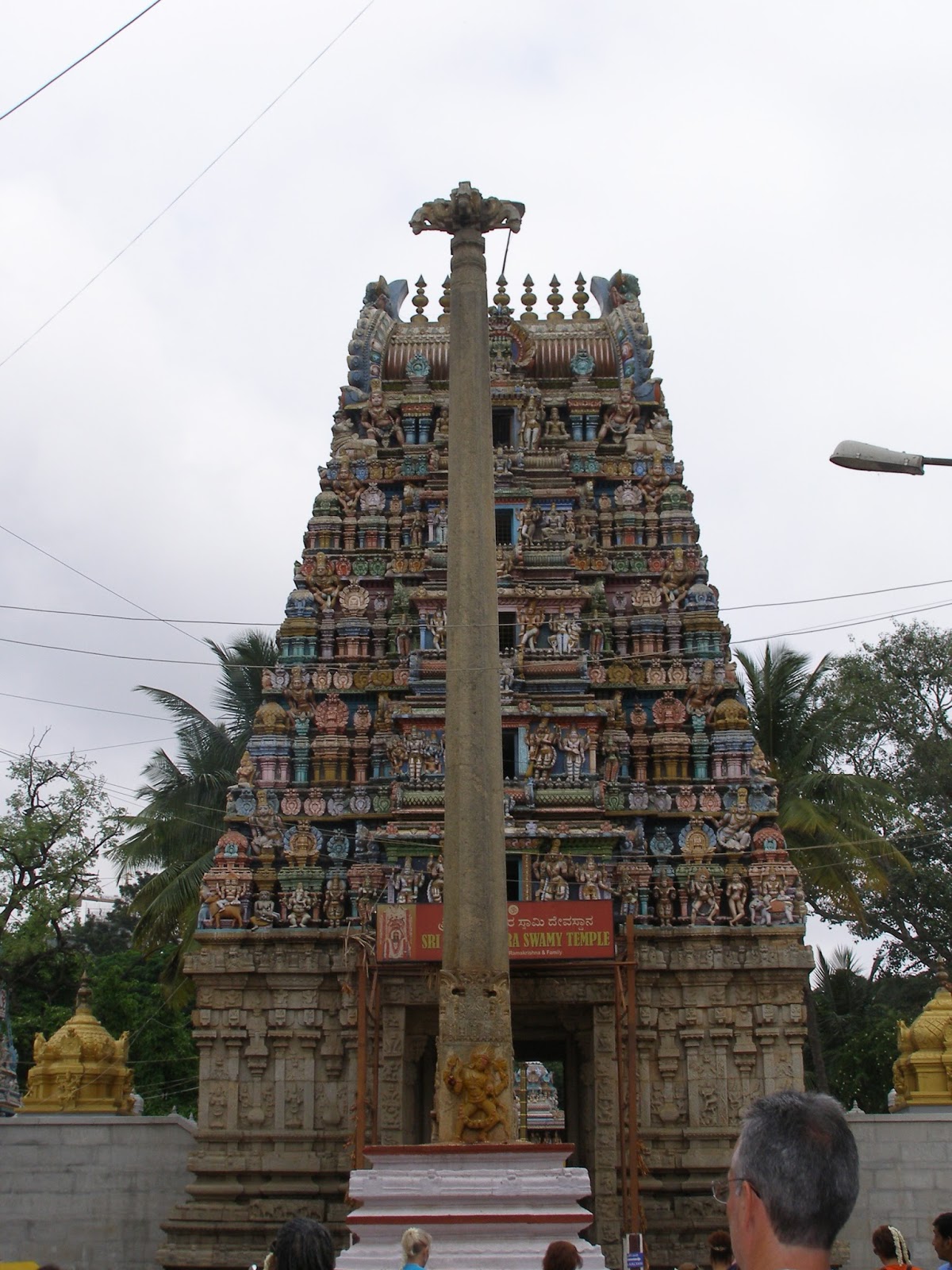
A Hindu temple outside of Ulsoor
A cow grazing in a littered lane.

Ulsoor market


Tuesday, July 9, 2013

Bangalore, Karnataka India...Unity in Diversity

After 18+ hours of flying, we arrived in Bangalore at 1:00 a.m. and to our hotel after 3:30 a.m. We were all happy to arrive, but traveling abroad demands that you are always thinking about what needs to be done next. With bloodshot eyes and the beginnings of hallucinations due to sleep deprivation, we very quickly shifted into figuring out where to exchange money for Indian rupees, how to manage settings on our cell phones so that we didn't have $100s of dollars in charges waiting for us when we got home and if indeed, the WiFi would work in the hotel. Bless the people who work in the hospitality industry, as they are eternally patient with us American travelers :-)
Hundreds of people waiting outside the Bengaluru Airport to pick up passengers

Licia, my partner teacher from Pennsylvania, and me @ Bengaluru Airport


Today, we listened to presentations on the foundations of the Indian education system and Indian culture and history. The prevailing theme of both presentations was that India is a place of unity within diversity. 

Friday, July 5, 2013

It's Monsoon Season...

Our gracious host in Rajkot, Gujarat on the western coast has prepared us for the monsoon season. She's advised us to bring an umbrella and rain gear. I've read that monsoon season is a time of revitalization for the country, since 80% of the country's rainfall occurs during the months of monsoon season (June -September). Take a look at these images from the 2013 season so far.


Wednesday, July 3, 2013

Land of Languages

As an English as a New Language teacher, I always love learning about the languages and culture of my students. I have had several Indian students over the years who spoke Tamil, Hindi, Gujarati and Telugu respectively. There are 22 "scheduled languages" of India, although Hindi and English are most commonly used for governmental and political communication. Each state of India can choose its official language. While many people speak English for everyday interactions, I am looking forward to learning a few helpful phrases. I'm sure my terrible pronunciation will be a great ice breaker!

Using the following links, you can listen to common Hindi phrases, see samples of the languages that abound in India and discover which location they are spoken.

(information in this post was excerpted from www.indiabook.com)

Quotes

Always seeking inspiration in words...


"India is, the cradle of the human race, the birthplace of human speech, the mother of history, the grandmother of legend, and the great-grandmother of tradition. Our most valuable and most instructive materials in the history of man are treasured up in India only."
- Mark Twain

"We're living in a time when the world has suddenly discovered India because it's run out of raw material for its imagination. The raw materials for imagination are inexhaustible here." -Deepak Chopra

"A nation's culture resides in the hearts and in the soul of its people."- Mahatma Gandhi


"If there is one place on the face of earth where all the dreams of living men have found a home from the very earliest days when man began the dream of existence, it is India!" -Romaine Rolland